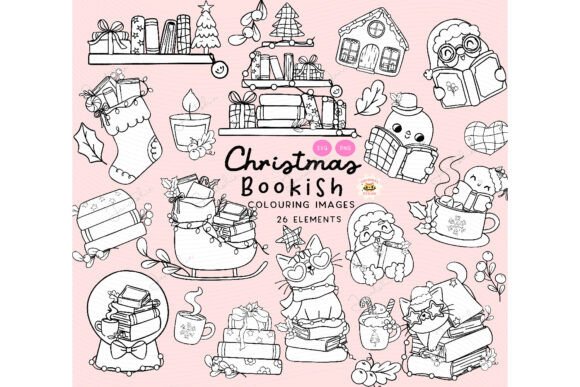
Reviewing Bookish Christmas Coloring Clipart PNG for Stitchers
As a designer who spends half my life digitizing and the other half stitching, I have learned that not every pretty image translates well to thread. When I first pulled up the Bookish Christmas Coloring Clipart PNG, my initial reaction was one of cautious optimism. The aesthetic is undeniably charming, tapping into that cozy, literary holiday vibe that has become so popular in recent years. However, looking at a digital illustration is vastly different from seeing it punched out in satin and fill stitches on a textured cotton towel or a fleece sweatshirt.
In this review, I am evaluating this asset not just as a graphic, but as a potential foundation for real-world embroidery projects. Whether you are an Etsy seller looking to expand your holiday catalog or a hobbyist making personalized gifts, understanding how these lines and shapes behave under the needle is crucial for a professional finished product.
First Impressions: Mood and Visual Personality
The Bookish Christmas Coloring Clipart PNG exudes a warm, nostalgic atmosphere. It combines the quiet joy of reading with the festive spirit of the season. Visually, the lines are clean, which is a good starting point for digitizers. The layout feels balanced, avoiding the clutter that often plagues holiday designs. For embroidery designers, this clarity is vital. Complex, messy illustrations require excessive stitch counts and often result in muddy textures when stitched out. This design’s relative simplicity suggests it could be adapted into a clean machine embroidery design without losing its core identity.
The theme naturally leans toward intellectual coziness. It is not loud or flashy; instead, it invites a slower, more appreciative glance. This makes it ideal for items meant to be held and used, such as tote bags, aprons, or pillow covers, where the user interacts with the design intimately.
Real-World Application: From Screen to Fabric
To truly test the viability of this clipart, I imagined applying it to several common substrates. Let’s consider a custom embroidered tote bag. Tote bags are typically made from canvas or heavy cotton, which have a visible weave. If you were to digitize this Illustrations asset for a tote, you would need to account for fabric texture. A simple running stitch might get lost in the weave, whereas a slightly denser fill stitch or a bold satin stitch border would make the design pop. The "bookish" element suggests thick outlines would work well, giving it a storybook illustration feel.
Another strong candidate is sweatshirt embroidery. Fleece and French terry are plush and forgiving, but they can swallow fine details. If you plan to use this design on a hoodie or crewneck, you must simplify the internal details of the clipart. The overall shape should remain recognizable even if the tiniest lines are removed. For a baby embroidery project, such as a onesie or a soft blanket, the design’s gentle nature fits perfectly. However, safety and comfort are paramount. You would need to ensure that any dense areas are backed properly with a soft cut-away stabilizer to prevent scratchiness against sensitive skin.
For those running a craft business, this design could also serve as a centerpiece for holiday embroidery patches. An embroidered patch allows for higher stitch density and more detail since it is stitched on a stable backing before being applied. This gives you more freedom to capture the nuances of the original PNG.
Technical Considerations and Potential Pitfalls
While the aesthetic is strong, there are technical hurdles to consider when converting a coloring clipart PNG into a functional embroidery file. Since this is a raster image (PNG) and not a vector or native embroidery format, you cannot simply load it into your machine. You must digitize it or hire a digitizer. This step is where many beginners stumble.
Stitch density is a major concern. Coloring pages often have many small, enclosed spaces. If you attempt to fill every tiny section with thread, the result will be stiff and may pucker the fabric. I recommend using a combination of stitch types. Use satin stitch for borders and larger solid areas, and reserve fill stitches for broader backgrounds. For very small details, consider using a single run of running stitch or omitting the detail entirely to maintain clarity.
Hoop size is another constraint. If you are working with a 4x4 inch hoop, you will need to crop or significantly simplify the design. A 5x7 or 6x10 hoop offers more breathing room, allowing the design to retain its proportions without cramping the elements. Always check the aspect ratio of the original clipart to ensure it fits your intended hoop without distortion.
Fabric choice matters immensely. Dark fabrics present a challenge for light-colored thread contrasts often found in coloring-style designs. If you are stitching on black or navy, you may need to add an underlay or use a topping to ensure the threads sit on top of the fabric fibers rather than sinking in. Conversely, on thin or stretchy fabrics like jersey tees, a heavy design can cause warping. In these cases, a lightweight tear-away stabilizer and reduced stitch density are essential.
Enhancing Product Value and Brand Consistency
Using high-quality, thematic assets like the Bookish Christmas Coloring Clipart PNG can elevate your brand perception. Customers associate clean, well-executed embroidery with professionalism. When the design aligns with the product—such as a literary-themed motif on a book lover’s tote—it creates an emotional connection. This increases the perceived value of the handmade product.
For Etsy sellers and small shop owners, consistency is key. If your brand focuses on cozy, intellectual, or vintage vibes, this design fits seamlessly into your existing lineup. It allows you to create a cohesive collection of holiday gifts, from kitchen towels to personalized apparel. Furthermore, using such distinct imagery helps your products stand out in crowded marketplaces. It is not just another generic snowflake; it tells a story.
Practical Designer Notes for Execution
Before you commit to production, follow these practical steps to ensure success:
- Test on scrap fabric: Always stitch a sample on the exact material you plan to use for the final product. This reveals issues with tension, puckering, or thread breaks.
- Check thread color contrast: View your digitized design in black and white. If the details disappear in grayscale, they will likely be hard to see when stitched. Adjust your color palette for maximum visibility.
- Review stitch density: Ensure the design is not too dense for the fabric weight. Heavy stitching on light fabric leads to distortion.
- Inspect small details: Zoom in on your digitized file. Are there tiny jumps or unnecessary nodes? Clean up the pathing to reduce thread waste and machine time.
- Verify licensing: Since this is a PNG clipart, confirm the license terms. Can you use it for commercial embroidery projects? Do you need to alter it significantly to claim it as your own design asset? Always respect intellectual property rights.
- Use proper stabilizer: Match the stabilizer to the fabric. Cut-away for knits and stretchy materials, tear-away for woven cottons, and wash-away for delicate or sheer fabrics.
In conclusion, the Bookish Christmas Coloring Clipart PNG is a promising starting point for holiday embroidery projects. It offers a unique blend of literary charm and festive warmth. However, its success depends entirely on thoughtful digitization and careful execution. By respecting the limitations of thread and fabric, and by testing thoroughly, you can transform this digital illustration into a tangible, high-quality finished product that delights customers and enhances your craft business.